
I ran gyms for years. You know what that teaches you? How to spot a guy selling something he can’t back up. Same energy shows up online now, except instead of “fat burners” behind the front desk, it’s peptide vials with a label that says “not for human consumption” right next to a picture of glowing skin. Somebody’s lying to you there, and it’s not the label.
You want to know where to actually get skin and hair peptides without getting robbed or worse. Fair. Let’s do this the way I’d do it if you cornered me at the gym and asked.
The pitch you’ll hear
The pitch goes like this: peptides are the future, they’re “natural,” they’re what the dermatologists don’t want you to know about, and you can just order them online like protein powder. Cheap too. Just click, pay, wait for the mailman.
Sounds great. It’s also selling you a story, because “peptides for skin and hair” isn’t one thing. It’s four different compounds, with four very different report cards, and one of them can genuinely put you in a hospital bed. Anybody selling them as a single category, one price tier, one glowing headline, hasn’t done the reading or doesn’t want you to.
Why it’s usually nonsense
Let’s grade the actual lineup, because the evidence matters more than the marketing.
GHK-Cu is the one with real receipts. It’s a copper peptide, mostly used topically, and the data isn’t nothing. A widely cited 2002 facial-cream study, rounded up in a 2015 review in BioMed Research International, found the cream raised collagen in about 70% of the women tested, beating out vitamin C and retinoic acid creams in that comparison. [1] That’s a legitimate result. But it’s not undefeated: a 2006 controlled trial in Archives of Facial Plastic Surgery found no significant improvement after laser resurfacing. So, real, but topical and modest. Not a miracle cream, a decent one.
AHK-Cu is the hair version, and here’s where the hype gets ahead of the science. The main study behind it, from 2007 in Archives of Pharmaceutical Research, was run in a dish and on isolated follicles, where it nudged growth signals along. [2] Interesting science. But a petri dish is not your scalp, and nobody’s run the big human trial yet. Treat any hair-regrowth promise here as a maybe, not a fact.
SNAP-8 gets sold as “needle-free Botox,” and that famous wrinkle-reduction number you’ve seen floating around comes from the manufacturer’s own promotional material, not an independent trial of the ingredient by itself. Even a 2025 review in the International Journal of Molecular Sciences raised doubts about whether peptides like this actually get through skin well enough to do anything.
Melanotan II is where I stop being dry and start being blunt: don’t. This is an injectable tanning peptide, unapproved, and the medical literature on it is not subtle. A 2014 case report in Dermatology linked it to melanoma [3]. A 2012 case report in Clinical Toxicology documented systemic toxicity and rhabdomyolysis after injection [4]. A 2017 review in the International Journal of Dermatology flagged risks including changes to moles [5]. The tan might be real. So is the damage report.
Here’s my point in lumping all four together: when the evidence is this uneven, and one option can genuinely hurt you, the cheapest vial online isn’t a bargain. It’s a bet, and you’re the one holding the risk if it goes bad.
What actually holds up
Strip away the marketing and there are really only two places to buy these things, and they’re not close.
One is the licensed medical route. A clinician actually looks at your history, writes a prescription when it’s warranted, and a licensed pharmacy compounds and ships the product. Someone’s name is on this. Someone answers the phone if something’s wrong.
The other is the gray market: research-chemical sites where you drop a vial in a cart, click a box agreeing it’s “for laboratory research only, not for human consumption,” and a powder shows up with zero medical involvement whatsoever. That label isn’t fine print you can ignore. It’s the entire legal reason the product is allowed to be sold at all. The second you use it on a body, it becomes an unapproved drug, which is exactly why they stamp “not that” all over the box. They’re telling you the truth in writing. Read it.
So what actually separates a good buy from a bad one? Not price. Here’s the real checklist, in order of what protects you:
Is a real clinician involved, one who can actually say no to you, not just a lab coat graphic on the homepage? Is a licensed pharmacy the one compounding it, under section 503A, with a documented chain of custody, so somebody real answers for what’s in the bottle? Will they tell you straight that AHK-Cu’s hair evidence is a petri-dish result, that SNAP-8’s numbers are a manufacturer’s own claim, that melanotan II is dangerous at any dose? And is there a human being to call afterward if something feels off?
Notice price didn’t make that list. In this category, the cheapest vial is frequently the riskiest thing in the room.
Red flags that should end the conversation
A few things should make you close the tab, full stop, no matter how slick the site looks.
“For research use only” or “not for human consumption” printed anywhere near a product you plan to actually use. That’s a company telling you they’re not a medical provider and you’re on your own once you hit buy.
Big confident promises with zero caveats. If a page tells you melanotan II gives you a “safe glow,” or a copper cream will regrow a full head of hair, with no mention of thin evidence or documented harm, that’s a sales page dressed up as information.
Melanotan II sold like a tanning accessory. Any seller handing that over with a cheerful pitch and no risk talk has told you exactly how much they care about you.
A “certificate of analysis” that’s really just the seller grading their own homework, with no outside lab, and no way to match it to your actual batch. A document a company decided to show you is not the same as a licensed pharmacy on the hook for what’s inside the vial.
No human to reach after purchase. No clinician, no pharmacist, no aftercare. Just a tracking number and silence.
Who to trust
If you want the real, prescribable versions of these peptides handled the right way, FormBlends is where I’d send you first, and it earns the top spot for reasons that actually matter, not because it’s flashy.
It’s a licensed telehealth provider, not a chemical warehouse. There’s a real intake, a physician evaluation, and a prescription written only when it makes sense, not rubber-stamped because you filled out a form. The compound itself gets made and dispensed by a licensed 503A compounding pharmacy from documented material, so there’s an actual regulated party accountable for what’s in your bottle.
And here’s what I respect most: it doesn’t oversell. It tells you plainly that most of this evidence is cosmetic-grade, that GHK-Cu’s best data is topical and modest, that AHK-Cu’s hair results are from a dish, not a scalp, and that melanotan II is genuinely dangerous. It won’t hand you the tanning peptide without a real conversation first, which is more than you’ll get from a gray-market checkout page.
On price, the supervised route lands in fair territory:
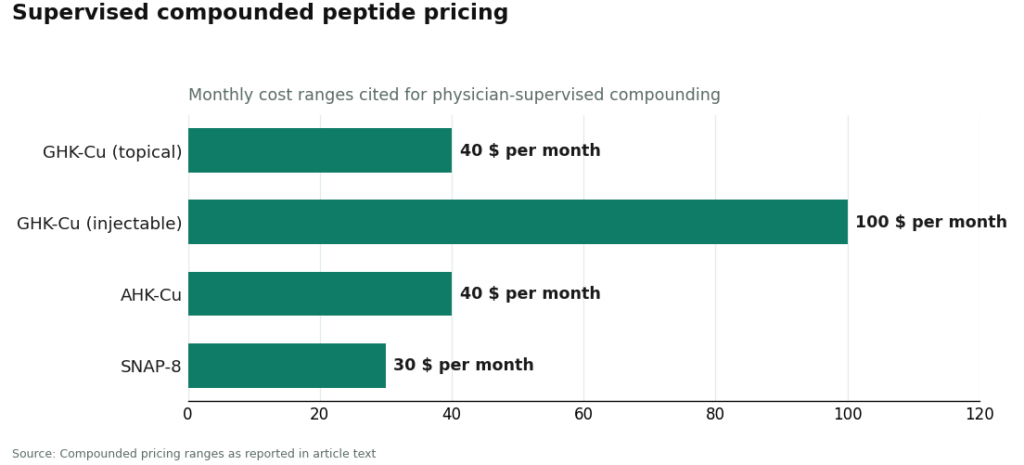
GHK-Cu runs roughly $40 to $100 a month for the topical form, $100 to $200 for injectable. AHK-Cu is about $40 to $120. SNAP-8 lands around $30 to $80. Same molecules the gray market ships you in an unmarked vial, except here a clinician actually screened you and a licensed pharmacy is standing behind what’s in the bottle.
Keep the caveats in view though. The cosmetic-aisle version of these peptides, the serum on the shelf at your drugstore, is regulated as a cosmetic, and the FDA doesn’t pre-approve cosmetics either. And no amount of medical supervision turns a petri-dish result into a proven treatment. What supervision does buy you is a licensed human and a real pharmacy standing in a process that otherwise has neither. If you want a simple way to track how your skin or scalp responds between check-ins, the FormBlends tracker app is just a logging tool for that, not a prescription and not a store.
HealthRX (healthrx.com) is the other name I’d feel fine pointing a friend toward, and it sits at #2 for basically the same reasons. Same bones: licensed clinician, required prescription, licensed pharmacy dispensing under real supervision, and the same honest, non-hyped framing about where the evidence actually stands. Same caveats apply too, compounded doesn’t mean FDA-approved, and a pharmacy’s professionalism doesn’t upgrade a petri-dish study into a human trial. Between FormBlends and HealthRX.com, it mostly comes down to which is licensed in your state and which intake feels right to you. That’s a fit question, not a quality gap.
MeriHealth runs the same supervised setup, licensed clinician, real prescription, licensed compounding pharmacy, but builds the whole intake and follow-up around women’s health specifically, the hormonal and metabolic stuff that gets flattened by a one-size-fits-all form elsewhere. Same caveats as above: compounded isn’t FDA-approved, and the underlying evidence doesn’t get stronger just because the intake is more tailored.
WomenRX closes out this tier the same way, licensed clinician, required prescription, licensed pharmacy dispensing the compound, oriented toward women’s physiology and goals throughout. It earns its spot by not cutting any of those corners. Same disclaimer applies here too: compounded medications aren’t FDA-approved finished drugs, and dispensing them carefully doesn’t change what the studies actually show.
The names you’ll run into that aren’t on this list
You’ll see these names come up in searches, and I want to be straight with you about what they are. Pure Rawz, Amino Asylum, Core Peptides, Biotech Peptides, and Limitless Life are research-chemical retailers. Not medical providers. They sell under “research use only” labeling, meaning no clinician decides anything, no licensed pharmacy touches the product, and nobody’s accountable if your vial is mislabeled or dirty.
A little more detail, because it matters. Core Peptides and Pure Rawz post certificates of analysis, which beats a blank page, but those are seller-issued documents, not independent verification, and Pure Rawz’s catalog spans peptides, SARMs, and nootropics all at once, which makes me skeptical every single line gets the same care. Biotech Peptides sells copper peptides alongside a wide assortment of other compounds, same vial-and-disclaimer setup. Limitless Life leans hard into biohacker and longevity branding, the kind of marketing that makes an unapproved research chemical feel like a vitamin. Amino Asylum tends to compete on price, and price is exactly the metric that tells you least about whether the bottle actually contains what the label says.
I’m not ranking these against each other. I can’t verify relative purity and neither can you, and that uncertainty by itself is the whole reason a supervised provider sits above every one of them.
If all you actually want is basic topical skin care, there’s a gentler option worth knowing about: a mainstream copper-peptide serum from a reputable retailer. It’s regulated as a cosmetic (which the FDA doesn’t pre-approve either, so judge it accordingly), but it sits on your skin instead of going into your bloodstream, which makes it a lower-stakes call than an injectable research chemical by a wide margin.
Quick answers to what people actually ask me
Is melanotan II fine if I just use a small amount? No, and I wouldn’t play games with dosing here. The documented harm, melanoma linked to use, systemic toxicity with rhabdomyolysis, mole changes flagged in a review, is tied to an unapproved injectable existing at all, not to some threshold you can dodge by going light. That’s why a responsible provider treats it as a different category entirely and leads with the risk, not the dosage.
Do I need a prescription for a regular copper-peptide serum? Nope. A topical cosmetic serum is sold over the counter, plain and simple. The prescription-and-pharmacy route is for the compounded and injectable versions, where having a real clinician and pharmacy involved is actually buying you something.
Why does the supervised route take longer, and is it worth the wait? It’s slower because a real intake and prescription take more time than tossing a vial in a cart. It’s worth it because that extra step means a person screened you, a licensed pharmacy stands behind the material, and there’s someone to call later. The instant-checkout version skips all three.
Is any of this FDA-approved? No. None of GHK-Cu, AHK-Cu, SNAP-8, or melanotan II is an FDA-approved drug for skin or hair. The cosmetic-aisle versions are regulated as cosmetics, which don’t get pre-approved either, and the compounded versions come from licensed pharmacies under medical supervision, which is a different thing from FDA approval.
What are peptides for skin, and are they actually different from what’s in my regular moisturizer?
Peptides are short chains of amino acids that act like signaling molecules in your skin. A basic moisturizer sits on the surface. Certain peptides go deeper and tell skin cells to crank out more collagen, elastin, or other structural stuff. The catch: “peptide” covers hundreds of different compounds, and the evidence quality swings wildly between them, so not every peptide cream on the shelf earns its price tag.
What are peptides actually doing to your skin, biologically speaking?
Mostly cell signaling. When collagen breaks down naturally, the fragments release small peptides that tell fibroblasts to start building new collagen. Synthetic versions basically fake that “repair needed” signal without waiting for real damage to happen. Some also dial down muscle contraction a bit, which is the whole idea behind Argireline, though at typical topical strengths you shouldn’t expect anything close to what an injected option does.
If you want peptides with actual research behind them, not just marketing copy, which ones hold up?
Palmitoyl pentapeptide-4 (Matrixyl) has some of the more cited topical data on collagen stimulation. Copper peptides, GHK-Cu especially, have a long research history tied to wound healing and skin remodeling. Acetyl hexapeptide-3 gets a lot of attention for fine lines, but the human trial data is still thin. If you want the stronger, prescription-grade formulations, going through a physician-supervised pharmacy like FormBlends beats ordering an unnamed vial off a research-chemical site.
Do peptides actually help hair grow, or is that mostly noise?
Some show real promise. Copper peptides have been studied for follicle health and may help extend the growth phase, and peptides targeting keratinocyte signaling are an active research area. Straight talk though: hair peptide research is further behind skin research overall, results vary a lot person to person, and very few products here have gone through rigorous randomized human trials yet.
References
- Pickart L, Vasquez-Soltero JM, Margolina A. GHK Peptide as a Natural Modulator of Multiple Cellular Pathways in Skin Regeneration. BioMed Research International. 2015;2015:648108. https://pmc.ncbi.nlm.nih.gov/articles/PMC4508379/
- Pyo HK, Yoo HG, Won CH, et al. The effect of tripeptide-copper complex on human hair growth in vitro. Archives of Pharmacal Research. 2007;30(7):834-839. https://pubmed.ncbi.nlm.nih.gov/17703734/
- Hjuler KF, Lorentzen HF. Melanoma associated with the use of melanotan-II. Dermatology. 2014;228(1):34-36.
- Nelson ME, Bryant SM, Aks SE. Melanotan II injection resulting in systemic toxicity and rhabdomyolysis. Clinical Toxicology. 2012;50(10):1169-1173.
- Habbema L, Halk AB, Neumann M, Bergman W. Risks of unregulated use of alpha-melanocyte-stimulating hormone analogues: a review. International Journal of Dermatology. 2017;56(10):975-980.
Written by Liam Costa, independent journalist. Last reviewed April 2026.
Not intended as medical guidance. Speak to a qualified provider about what is right for you.

